Tuesday, July 27, 2010

Let there be Light!

Well once the difficulty with the direction of the joist was done it became a much more straight forward task.  Running the three new gang boxes was not that hard, just a bit messy cutting into the drywall.  A circle cutter on a rotary tool sure makes a nice cut-out though!


So here is the garage with the 6 new lights on at about 7:30 pm on a summer evening.


Here on the right you can see how each original position now has another fixture in front of it


And here you can see from the other direction.

So 6 fixtures, 12 32w T8 bulbs makes for a nice improvement on the original lighting.  There is still room to easily add an additional 3 gang boxes back in the direction of the garage doors if needed. 

For now I'll just go with this.

Sunday, July 25, 2010

It's always something

Well,  my first thought was to mount these lights with three in the current location and then put two others in the opposite orientation in between the car bays, that would give light in the space between cars.

Well one tip I' have now it to investigate fully the direction of you ceiling joists and also the joist material.  As it turns out in order to run flexible wire in the ceiling from the current fixture over to a new gang box over the spaces  between the bays, I have to get through multiple joist as they run from the front to the back of the garage in the direction of the cars!

To make matters worse  I tried with one by removing a small 4" strip of drywall and found one area of 8" think laminated beam.  This obviously was a major load bearing beam for the guest bedroom above the garage.


So a change of plans I will now run the wire to new gang boxes that are located within the same joist space to make this job much easier.  So I will run the wire about 4' forward and drop in new gang boxes like these for adding boxes to existing walls.


We'll go with that plan and I'll show you the finished product.

Saturday, July 24, 2010

Can you see what your doing

I guess the first thing I wanted to start with is lighting.  Most people will agree you just can't have enough.  Here I share some of my experience with doing an upgrade to the typical "builder installed" garage lighting.

This is typically the type of thing you will be starting with.


This is a 3 car garage with some outdoor lighting each with 2, 100 watt bulbs located directly over the car bays.  Bad on multiple counts,  incandescent lights, poor placement, and just inadequate.

While you could toss all kinds of money at this job, my intention was to get good bang for the buck, so I wanted to solve the most problems for the least cost and the easiest install.

Easiest would be just to toss 3 replacement fixtures into these existing spots but that doesn't help with the placement.  If you are working on the cars you'll need light from multiple position to fill in shadows.  So just 3 larger, brighter was not the idea.


So I decide to go with 6, 2x32 watt fixture, using 2 per bay. These were purchase for a local home center, at $19.99 each they are cheap enough.  The 4x32 fixture were almost triple in cost so I decide to go with 2x32 to save money and spread the lighting.  So the lights and bulbs come to about $135.


Next we get into the layout and install.  Of course nothing goes as planned!

Thursday, June 10, 2010

Lift it #3

The electrical requirements on this Atlas lift were a little sketchy, I'll tell you the manual is terrible,  written by those who speak a different native language.  The manual states a 40A, 110v circuit. I thought that was odd.  I checked with the retailer and they told me a 30A, 110v circuit.  Unforetunately my garage only had a 15A 110v circuit currently so I would have to do a full upgrade, running a new circuit back to the panel.

So some 10/2 wire and a 30A breaker was the call since the retailer said that was what it needed,  I thought 30A was overkill but didn't want to do a 20A and have it not work.  When I first tested in the 15A circuit it worked fine, until I put a car on it and it tripped the beaker every time.

This lift also does not ship with a cord end so be prepared to wire up the end for the receptacle you need.

Sunday, June 6, 2010

Lift it #2

OK,  well now the lift is in place but with low profile cars like both corvettes I need to have ramps to get those cars over the lift.  The C4 corvette will park over this lift on a regular basis, so I want the ramps to be built to a good standard, look fairly good, but I also want them to be able to break down into piece and I want them to be movable, without a hernia!

So instead of stacked 2x10 or 2x12 lumber, I'm building these with three 2x4 ribs and covered with plywood,  I ran each 2x4 through a table saw to true up the edges and to take the height down just a bit.  So there will be one rib on each side and one down the middle.  The plywood is glued and nailed onto the 2x4 ribs.

Another big part of this design is that the ramps are built in 3 sections, the angled ramp section, the main long section, and another small section to extend the front.  Each of the section can be removed from the front of the back of the ramp once the car is lifted to gain greater access to the front or rear area of the car.  This allows more freedom for a wheeled shop seat, engine or transmission stand.

In this picture you can see that the 2x4 ribs are notched where the pieces come together.  These joints are held together with 3/8" threaded rod, I put a hex nut on one end of a section and just welded the hex nut in place, esentially creating a 14" long 3/8" bolt.  That slides through all the ribs and on the last rid a "Tee Nut" is embedded in the rib and the whole assembly bolts together.


The thing I like about making the ramps this way is you can easily create a extra long ramp front piece with a very gentle rise.  With cars like corvettes the typical ramp angle will not due, they hit the front and that tend to just push the ramps on the concrete.  The other thing I do is to use a very thing plywood section as the front of the ramp so that the front tires get onto the ramp and apply some weight to the ramp, this helps it to stick in place and not just push backwards.

So the finished product of the ramps with the lift in place looks like this.  I spent a lot of extra time painting as I wanted it to look good, no bare wood, and it will help keep it from rotting when I park over it when things are wet.

Just a little electrical work to do now.

Sunday, May 30, 2010

Lift it #1

This is a chronicle of the transportation, install and a few project using a mid-rise lift.  These style mid-rise lifts are available from several manufacturers, I chose the Atlas TD6MR based on recommendations, costs, and availability.  Pricing may vary but at this time expect to pay about $1400 for this lift.

Here is my experience with the lift day 1.


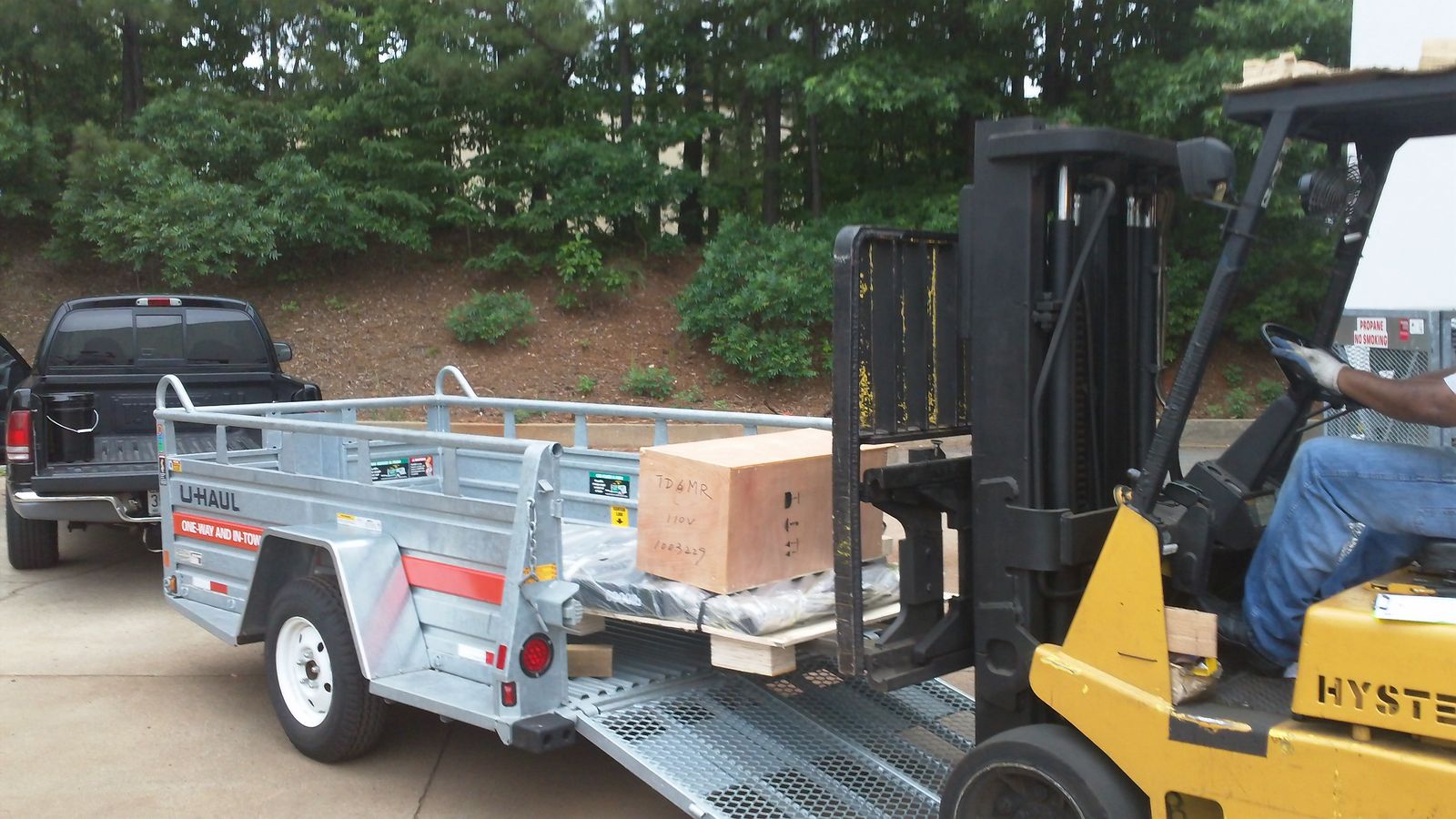
First I rented a U-haul 5x9 trailer with the long tilt ramp, this trailer is very heavy for this size, way over built, it weighs about 1250#, but the pallet fits right in. One thing I did to make life easy for unloading was put some 4x4 post pieces under the pallet so I would have plenty of room to get under it once at home.


Once at home I used two floor jacks to slowly ease it back and out of the trailer, it required many times of repositioning the jacks but not too bad.


To get this 900# lift off the pallet was my jacks was my old $29 floor jack, I ran some chain around the far end you can see just to lift the end so that it begins to clear the pallet. Then I lifted the opposite end enough to get two black pipe lengths under the middle and began rolling it off.  Don't forget to use this trick it help build the Pyramids after all!  It moved easily off the pallet.


In its spot!  If you have "normal" sedan and SUV vehicles you might be able to park over the top of the lift with no ramps, you need about 5 3/4" clearance, but with a couple corvettes and one that is lowered that is not a possibility here. 

So next is to construct ramps.